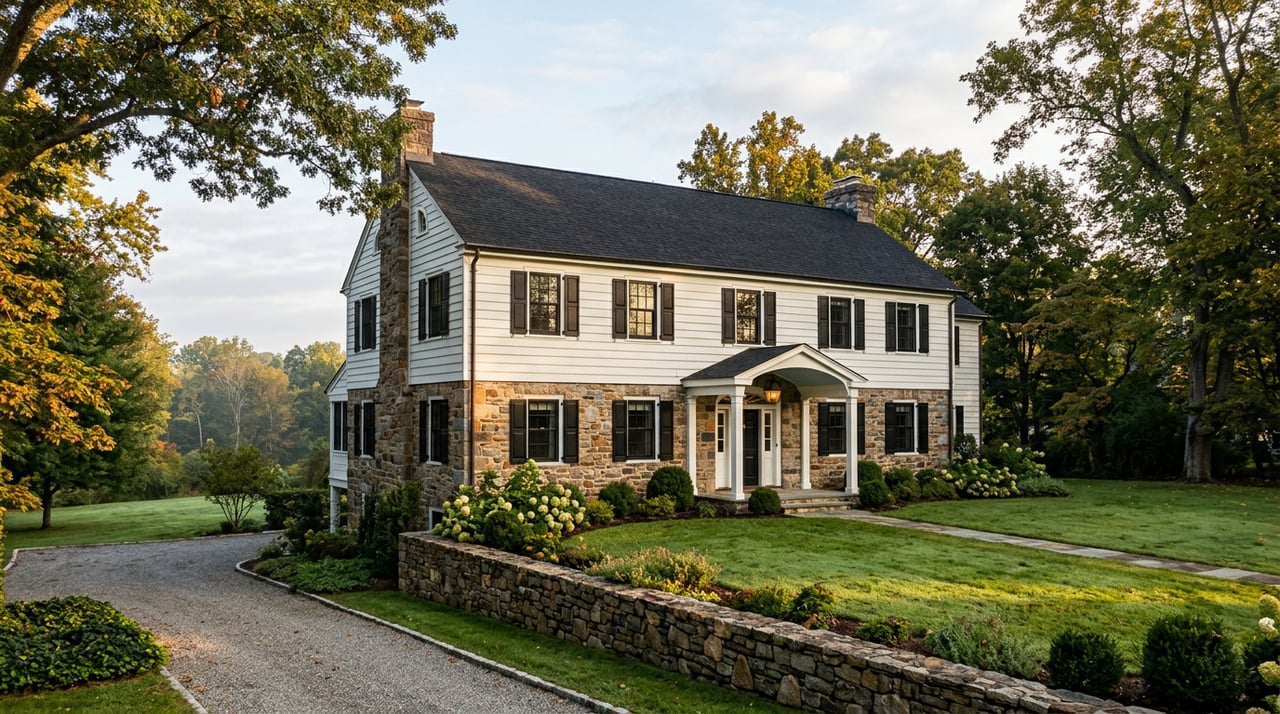
Search "Goshen NY home prices" this week and you will collect a folder of contradictions. One source says the median sold for $557,900 over the past year. Another says $579,900. A third, compiled from town clerk filings, says $651,000, a historic high. A fourth, tracking what sellers are currently asking rather than what buyers are currently paying, says $742,000. None of these people are lying to you. They are measuring different things, in a market small enough that the measurement itself becomes part of the story.
If you are comparing Goshen to Warwick, Chester, or Middletown before making an offer, the gap between these numbers matters more than any single one of them. Here is what each figure is actually counting, and what that means for the offer you are about to write.
Five Numbers, Same Goshen Area, Same Year
Line them up and the pattern becomes obvious. Every one of these covers activity from the past twelve months or less, and each is labeled Goshen; the geographic scope behind a number still matters.
| Source | What it measures | Figure | Window |
|---|---|---|---|
| Trailing 12-month sold median | Actual closings, one full year | $651,000 | Period ending Feb. 28, 2026 |
| Rolling 3-month smoothed median | Actual closings, recent quarter | $579,900 | Early 2026 |
| Trailing 12-month sold median | Actual closings, one full year | $557,900 | 12 months to roughly mid-2026 |
| Current asking price | Active listings, not yet sold | $742,000 | August 2026 |
| Rolling 3-month mean (average) | Actual closings, recent quarter | $665,089 | Early 2026 |
Three of these are medians on closed sales and they still disagree by close to $100,000. That is not a data error. It is what happens when a market this small gets treated like a statistical sample.
The Six-Sale Problem
A 12-month trailing report covering the period ending February 28, 2026 put Goshen's single-family median at $651,000, a historic high for the town. That was up just 1 percent from the $642,000 median recorded the year before, but up 18 percent from $552,500 two years earlier. The number climbed steadily. What did not climb was the sample it was built on: only 36 single-family homes sold in that 12-month window, down from 44 the year before and 46 the year before that. Historically, Goshen sees somewhere between 35 and 60 single-family transactions a year. As of March 27, 2026, there were only six single-family homes on the market in the entire town, two of them brand new listings.
That is the whole mechanism in one sentence. When a "typical" market clears 35 to 60 homes a year, a single $900,000 sale or a single $135,000 sale can move the median by tens of thousands of dollars, because there is no volume to absorb it. One separate report found that a single month in 2026 saw the monthly median spike to a record $732,500 on just six closings, while price per square foot barely moved. The square footage math stayed flat. The headline number did not, because six sales is not a market, it is a small sample that happens to close in the same 30 days.
This is why the 3-month smoothed median settles closer to $579,900 even as the 12-month trailing figure sits north of $650,000. Neither is wrong. One is absorbing a full year of high-end outliers into a longer average. The other is closer to what is actually happening on the ground right now, with fewer data points to smooth it out.
Asking Price Is Not Selling Price
The fourth number, the $742,000 figure from August 2026, measures something different again: what sellers are currently asking, not what buyers are currently paying. It is up 7 percent year over year on a $290-per-square-foot basis. That gap between what is listed and what closes is not unique to Goshen, but it is more visible here because inventory is so thin that a handful of ambitious list prices can pull the asking-price average well above what the last several closings actually supported.
If you are working from a portal's asking-price figure to gauge whether a specific house is priced fairly, you are comparing it to other sellers' hopes, not to other buyers' decisions. The closed-sale medians, even with their volatility, are the closer read on what the market will actually bear.
One Name, Two Towns
There is a second layer to this that has nothing to do with sample size, and it explains why "Goshen" can describe two genuinely different living situations under one price tag.
There is a Village of Goshen, incorporated in 1809, and there is a much larger Town of Goshen that surrounds it. The Village is the walkable core: Main Street, the county courthouse, the Orange County Government Center, the DMV, the Historic Track, and Village Hall at 276 Main Street. It hosts the Farmers' Market, the Great American Weekend, the Mid-Hudson St. Patrick's Day Parade, and Goshen Illuminate. The Harness Racing Museum and Hall of Fame sits in a Tudor-style stable next to the Track. The paved Heritage Trail runs directly through the Village center and connects out toward Monroe and Middletown.
The Town of Goshen is everything around that core: larger residential lots, rural acreage, properties that require a car for daily errands rather than a five-minute walk. Both fall under a single property assessor. The Town of Goshen Assessor's Office establishes values for all real property within the Town, which by definition includes the Village of Goshen sitting inside it.
That means a single town-level median price is blending a walkable quarter-acre lot two blocks from the courthouse with a rural ten-acre parcel on the edge of town, and reporting the result as one "Goshen" number. If you are choosing between village-adjacent convenience and town-level acreage, the median tells you almost nothing about which one you are actually buying, because it was never built to distinguish between them.
What This Means When You're Comparing Goshen to Somewhere Else
Goshen is genuinely a premium market within Orange County. The countywide median runs somewhere between $429,000 and $456,000, meaning Goshen's various closed-sale medians, whether you use $557,900 or $579,900 or $651,000, all sit meaningfully above the county baseline. That premium reflects the county-seat amenities, the walkable Village center, and the school district, and it holds up regardless of which specific Goshen figure you quote. Note also that region-wide MLS medians covering the broader downstate area (roughly $774,000) fold in Westchester, Rockland, and other counties well outside the Hudson Valley, so that figure is not a useful local comparison point for Goshen at all.
The practical takeaway, if you are actively comparing neighborhoods rather than just browsing:
Ask which window a quoted number covers. A 12-month trailing median, a 3-month smoothed median, and a single month's closings will all describe the same town differently, sometimes by six figures, without either being inaccurate.
Ask whether the figure is built from closed sales or current asking prices. An asking-price median tells you what sellers hope for. A sold-price median tells you what buyers have actually agreed to pay.
Ask whether the listing sits inside the walkable Village or out in the surrounding Town. The lifestyle, the daily errands, and the lot size attached to that address will differ substantially even though both carry the same "Goshen, NY" label.
A Few Questions Worth Asking Before You Compare
Is Goshen's market going up or down right now? Depends on the window. The 12-month trailing figure through February 2026 hit a historic high of $651,000. A tighter 3-month smoothed figure settles closer to $579,900. Both are real. The longer window is absorbing more of the past year's high-end closings, the shorter one is closer to the current pace.
How many homes actually sell in Goshen in a typical year? Historically between 35 and 60 single-family transactions annually, with 36 closing in the 12 months ending February 28, 2026. That is a small enough sample that any single high-end or low-end sale can shift the headline median noticeably.
Does it matter whether a listing is in the Village of Goshen or the Town of Goshen? For daily life, yes. The Village is the walkable core with Main Street, the courthouse, the Historic Track, and the Farmers' Market within a short walk. The surrounding Town offers larger lots and more rural settings but requires a car for most errands. Both are assessed by the same Town of Goshen Assessor's Office and both get reported under the single town-level median.
If you are trying to figure out what a specific Goshen number actually means for a specific address, that is exactly the kind of question a monthly aggregate cannot answer on its own. Carmela Lopez Borrazas works this market address by address, from the walkable blocks around the Track to the larger parcels on the outskirts, and can tell you which window and which pocket of Goshen your number is really describing. Let's Connect.