Track Warwick, New York's reported median home price over the past fourteen months and you get something closer to a seismograph than a chart. In June 2025, one report put the median sale price at $674,900. By November 2025, another put it at $433,000, a swing described as a 40.2 percent year-over-year drop. By June 2026, a different tracker had the median list price back up to $634,000. By mid-August 2026, another put the median home value at $606,074, up 4.28 percent from a year earlier. Same town, fourteen months, a range of more than $240,000.
None of these numbers is wrong. They're all measuring something real. The problem is that "median home price in Warwick" isn't one stable number you can look up. It's a snapshot of whatever handful of houses happened to close that month, and in a town this size, that handful can look wildly different from one stretch to the next.
Twelve Sales Is Not a Market, It's a Sample
Here's the detail that explains everything: one report counted 130 homes selling in Warwick in June 2025. Five months later, in November 2025, another count put the figure at just 12. That's not a typo, that's an eleven-fold difference in sample size depending on which month you check.
When a dataset that thin is your entire sample, a single high sale and a single low sale sitting next to each other can swing the median by six figures depending on which side of the middle they land on. A run of closings recorded within an eleven-day span, December 30, 2025 through January 9, 2026, shows exactly how much spread hides inside a small batch: a 1,585-square-foot home at 123 Newport Bridge Rd sold for $347,700, a 1,734-square-foot home at 76 Laudaten Way sold for $380,000, a 1,900-square-foot home at 30 Highland Ave sold for $575,000, and a 2,564-square-foot home at 65 Wilhelm Dr sold for $902,000. Run the median on that four-home batch and you get one number. Swap in a different four sales from a different week and you get a completely different one.
This is why a headline that says Warwick's median dropped 40.2 percent in November 2025 and a headline that says it climbed 4.28 percent by August 2026 can both be technically accurate and both be nearly useless for figuring out what's actually happening to values in town. Neither is describing a trend. Both are describing a sample.
The Number That Actually Held Steady
If you want a figure that isn't jumping around based on which handful of houses closed, look at price per square foot instead of median price. Track it across the same fourteen-month window and it barely moved: $290 per square foot in June 2025, $303 per square foot in November 2025 (up 2.9 percent year over year), and $297 per square foot in June 2026. Three different snapshots spread across a full year, and they all land within thirteen dollars of each other.
That tightness is the tell. When median price swings by six figures but price per square foot holds inside a narrow band, the underlying value of Warwick real estate hasn't cratered or spiked. What's changed is the mix of homes that happened to sell. A month heavy on starter ranches pulls the median down. A month with a couple of larger new builds pulls it up. The square-footage math cancels most of that noise out because it normalizes for size instead of getting yanked around by which price bracket happened to transact.
If you're comparing Warwick to another Hudson Valley town, or trying to figure out whether a listing is priced fairly, price per square foot is the number to anchor on. Median price is the number to read with a raised eyebrow.
Twenty-Seven Lots About to Land in the Mix
Here's where this stops being an abstract statistics lesson and starts mattering for anyone shopping in Warwick over the next year. The Town of Warwick Planning Board's agenda for its March 18, 2026 meeting listed a final approval application from Warwick Isle Group, Inc. for a 27-lot cluster subdivision, filed as Section 2 and Section 3 of a larger 33-lot plan on the parcel where County Route 1 meets Merrits Island Road, just off Pine Island Turnpike. Public records reviewed for this piece don't show the outcome of that specific hearing, but the filing itself confirms the next phase of the project was moving through final approval as of that date.
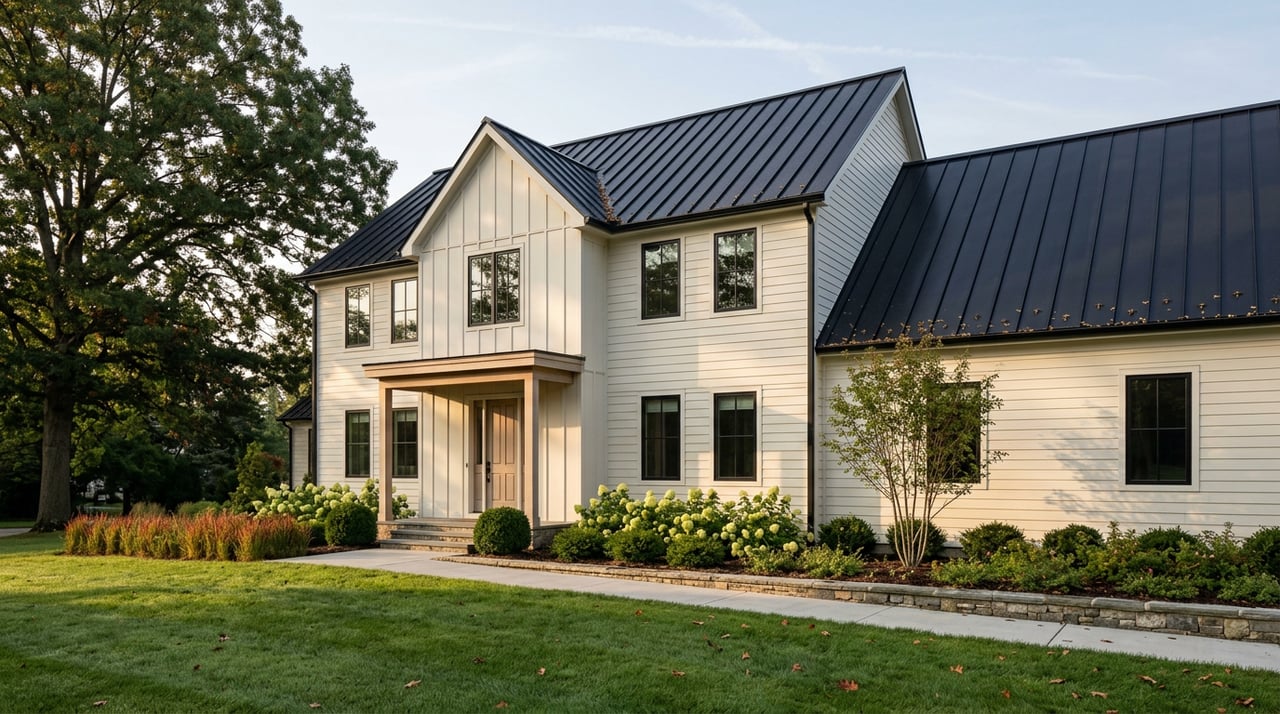
That parcel is the same Warwick Isle development that's been building out on Warwick Isle Boulevard: an 80-acre community founded by Jamie and Bob Bogert, built around Passive House-influenced, fully electric homes with names like the Twin Peaks, the Alpine, and the Plateau. Current pricing on those homes runs from the $600,000s up to $1.2 million and beyond, with larger models like the Plateau approaching 4,100 finished square feet plus bonus space.
Sit with what that means for the median math above. Warwick's reported median has bounced between roughly $433,000 and $675,000 over the past fourteen months, largely because so few homes sell there in any given stretch. Now add a batch of 27 additional lots, most of them destined for homes priced well above that range, into a market that thin. When those closings start hitting the record books in clusters rather than trickling in one at a time, they won't just add inventory. They'll pull the reported median upward in whatever month they close, the same mechanical effect that the $902,000 sale had on the four-home sample above, just scaled up.
This isn't a forecast that Warwick prices are about to jump. It's a statement about how the reported number will behave once a concentrated wave of $600,000-to-$1.2-million new construction starts converting from approved lots to closed sales. Anyone reading next year's median-price headline without knowing that context will be tempted to draw conclusions about "the market" that are really just conclusions about a subdivision's construction schedule.
What to Actually Watch If You're Shopping or Selling Here
A few practical shifts follow from all this.
- Stop anchoring on month-to-month median price changes and start tracking price per square foot over a longer window. It moves less and tells you more.
- Watch active inventory count alongside price. One tracker put Warwick's active listings at 134 as of mid-2026, a steadier backdrop than the monthly sale-count swings suggest.
- If you're shopping in the $600,000-to-$1.2-million bracket, expect competition from Warwick Isle's next phase as those 27 lots move from approved to built to listed. That's new supply entering your exact price range, not the broader market.
- If you're selling a home well below that bracket, a spiking town-wide median driven by new-construction closings elsewhere doesn't mean your home just got more valuable. It means the sample shifted, not your comp pool.
- Ask any agent quoting you a "median" what time window and what sample size sits behind it. In a market this thin, that context matters as much as the number itself.
FAQ
Is Warwick's housing market actually slowing down? The data doesn't support a clean answer either way. Reported medians have moved in both directions depending on the month and the source, but price per square foot, the steadier metric, has stayed close to level. The honest read is that Warwick's low transaction volume makes single-month median swings unreliable as a trend signal on their own.
When will Warwick Isle's next phase actually be for sale? Earlier sections of the development already have completed, sold homes, including a roughly 2,500-square-foot house on Warwick Isle Boulevard built in 2025. The 27-lot Section 2 and Section 3 filing is a different, later phase of the same 33-lot plan, and as of the March 2026 Planning Board agenda it was still moving through final subdivision approval rather than sitting ready to build. Buyers interested in that specific phase should expect a lag between approval and closings, consistent with how new construction typically moves through a town's review process.
Should I wait for new construction instead of buying an existing home? That depends on what you're trying to buy. Existing homes in Warwick span a wide range, from historic colonials near the village to larger rural parcels, and many of those won't be replaced by anything Warwick Isle is building. If your target is specifically the eco-focused, all-electric new-construction segment, the Section 2/3 approval is worth tracking. If you want an established neighborhood with mature trees and a different price point, waiting doesn't help you.
There's a difference between reading a market and reading a headline number that happens to describe a market. Warwick right now is a case study in that gap, and it's about to get more pronounced as Warwick Isle's next section moves from approved plans to closed sales. If you want a read on what a specific listing, or a specific price bracket, actually looks like against that backdrop, Carmela Lopez Borrazas can walk you through the comps that matter for your situation instead of the headline that doesn't. Let's Connect.